

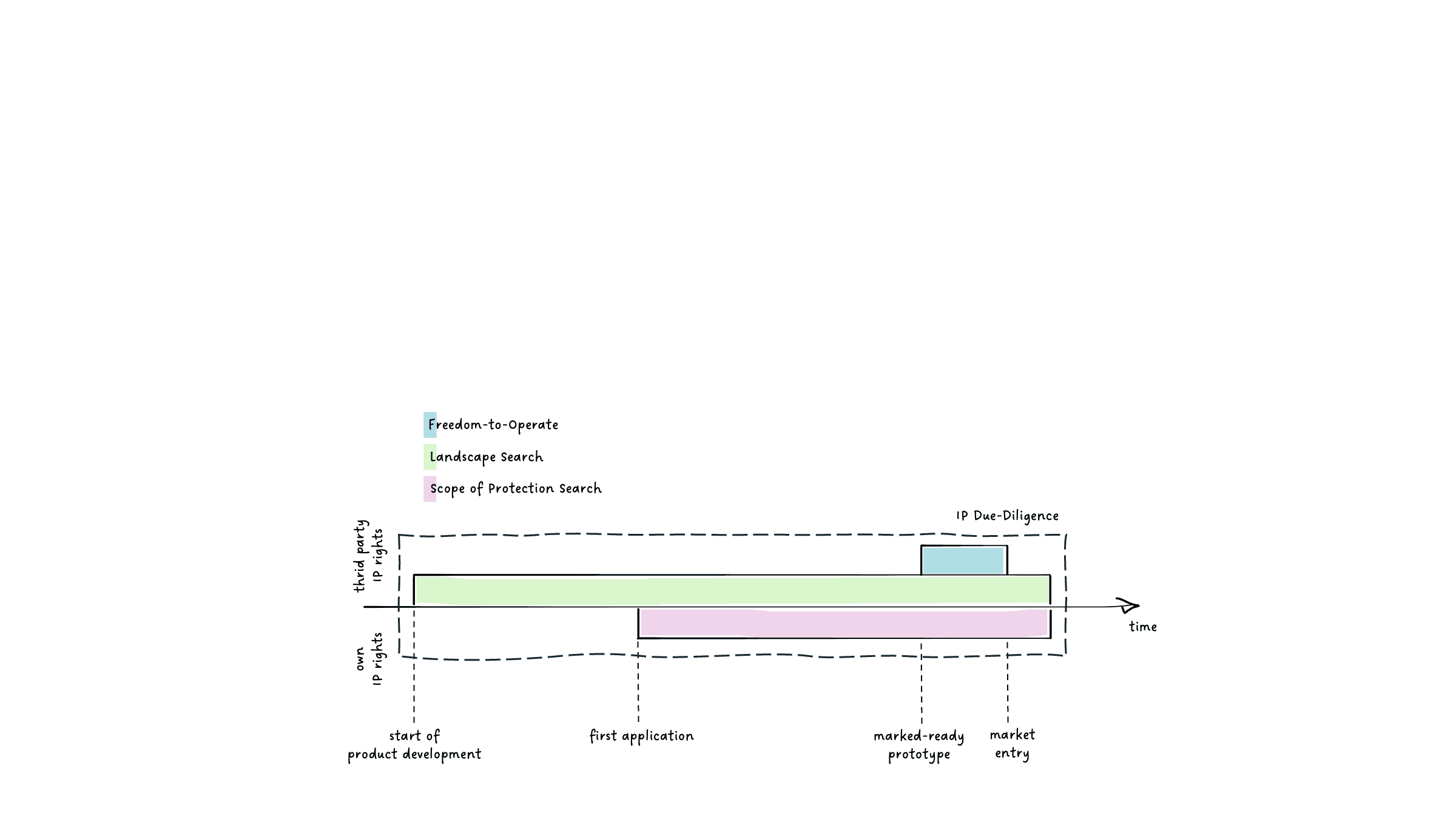
In practice, the term “Freedom-to-Operate” (FTO) is often used broadly to refer to a variety of issues. However, depending on the intention of the client and the stage of a product’s development, the term FTO encompasses various IP analyses that must be clearly distinguished from one another and will be explained in more detail here.
From a patent attorney’s perspective, the mention of an FTO analysis initially causes a spike in blood pressure, as this term is traditionally understood to refer to the final and highly detailed assessment of whether a fully developed product can be launched into a specific market without infringing on third-party intellectual property rights that are currently in force. Even though the resulting conclusion by no means constitutes an absolute guarantee, it nevertheless has significant implications and carries a considerable liability risk.
- The Traditional FTO Analysis
For a thorough FTO analysis, an infringement analysis is conducted for every intellectual property right that has the potential to restrict the product under evaluation, and the legal validity of that intellectual property right is scrutinized.
For example, if a company independently develops an mRNA for a vaccine, the technical implementation may still be relevant to third-party intellectual property rights. Not only will the mRNA sequence be relevant, but in particular, subcomponents, stabilizers, or packaging elements, defined lipid nanoparticles (LNPs), formulations, or manufacturing processes for the mRNA may also be subject to independent intellectual property rights that must be reviewed.
While there is considerable leeway for purely scientific or academic research, commercial use requires compliance with any existing intellectual property rights. An FTO analysis therefore considers not only the core of the invention itself but also requires a broader examination of all aspects of the product to be marketed.
This task can only be addressed to a limited extent if the FTO analysis is to be conducted for a product that is still in development and is expected to undergo several rounds of modifications before reaching market readiness. Even minor changes can result in the need to obtain a license from a competitor or to consider additional intellectual property rights.
No patent attorney would rashly make a definitive statement given such an unclear starting point. A thorough and comprehensive FTO analysis therefore generally requires that the product already be fully defined from a technical standpoint.
- Accompanying Patent Searches
However, patent searches or IP analyses are also of great importance long before product development is complete. Investors, startups, or R&D teams therefore often use the term “FTO” in a much broader sense. In the early stages of product development, however, this does not refer to a traditional FTO analysis—that is, approval for market entry—but rather an assessment of the status quo of one’s own innovations, an evaluation of the financial costs or risks involved, and often a better understanding of the technical or competitive landscape.
Specifically, such patent searches seek answers to the question of which potential intellectual property rights, risks, and relevant competitors must be considered in further product development (landscape search).
Complementary research can be supplemented by regularly monitoring the activities of relevant competitors in order to better assess their developments and growth potential (competitor research). It is also particularly important to examine the level of protection provided by the company’s own patents. This involves determining whether the company’s own patents provide sufficient protection for a product under development (scope-of-protection research).
To provide more clarity here—and to help patent attorneys sleep more soundly—we will attempt to classify the various terms below.
Generally speaking, there are three distinct types of relevant IP searches.
# 1 – The Landscape Search
Research Question – Which potential intellectual property rights, competitors, and key development areas are already known in the relevant technology field, need to be considered, and should be monitored over the course of further development?
Content – A strategic overview of patent landscapes, competitors, and filing trends, but no specific assessment of the state of the art or infringement for market entry.
Target Audience – R&D teams and startups during product or process development; investors as part of the due diligence process prior to an investment.
Objective – To provide a basis for decision-making regarding further product development.
# 2 – Scope of Protection Search
Research Question – Is the product sufficiently protected by the developing company’s own patents?
Content – Detailed analysis of individual patents or patent claims with regard to the product to be protected or the underlying technology. For pending patent applications, an assessment of the potential future development of the scope of protection and the likelihood of grant can also be provided.
Target audience – Investors or buyers as part of the due diligence process for risk assessment prior to investing in the technology.
Objective – To provide a basis for decision-making regarding upcoming investments.
#3 – The Premier Category: “Freedom to Operate”
Question – Can a specific product or process be used, manufactured, or distributed in a particular geographic market without infringing on third-party intellectual property rights?
Content – Analysis of relevant, active intellectual property rights with regard to a specific product or process in all its components. Assessment of potential infringement risks and possible courses of action (e.g., licensing).
Target Audience – Companies with a fully developed product or process prior to market entry.
Objective – To assess the litigation risk and related claims for damages arising from the market launch.


- April 17, 2026
 March 27, 2026
The Greenland Shark and the Interpretation of Declarations of Intent
Ecosystems do not adhere to the artificial boundaries between countries that we have created. Rather, they extend beyond national borders.
 March 19, 2026
A New Era for Computer-Implemented Inventions in Australia
Australia’s Federal Supreme Court (the ‘High Court of Australia’) dashed hopes for greater clarity in the patentability of computer-implemented inventions when, in 2022, it handed down a 3–3 split decision in _Aristocrat Technologies Australia Pty Ltd v Commissioner of Patents_ ([2022] HCA 29).

New legal framework for NGT (new genomic techniques) plants and easing concerns on the issue of their patentability
Just before the end of 2025, the EU Parliament and the EU Council reached an exciting agreement that should lead to a novel uniform legal framework for new genomic techniques (NGT).


